Monday, October 3, 2016

Revision:Race as it stands

Nyveah Fuller                                                                                                     
10/03/2016

                                                   
                                                   Revision: Race as it stands


Race is often something that is seen as skin deep and nothing more. Race as a scientific concept is viewed as a population of people who have similar characteristics and these populations are perceived different based on those characteristics that are shared. To classify races scientist consider features such as, hair type, skin color and face shape just to name a few. Scientist conceptualize race based ones appearance For example, “On the basis of skin color, we might be tempted to label these people as African, but on the basis of hair and facial shape they might be classified as European,”  (Relethford, 2016). In the documentary “Race: The Power of an Illusion, Episode 1” As Evelen Hammods stated something within the effect of Scientists are part of their social of their social context and that their idea are not solely based on science but from the society in which they live. Which makes sense because many people view races based on their society, where they live where they grew up or from things they were taught early on. Many people who grow up racists have grown up in households where many of their families members are racist therefore they grow up thinking that is the way of life they should live because they do not know anything else. Race from a sociological is viewed based on ethnicity, political and economic. Sociologists ask questions about race to understand it’s origin and ethnicity groups.
Add captionhttp://hrvcanada.blogspot.com/2011/08/racism-and-prejudices.html


My racial identity is African American and I see myself as an American black woman my mom is a black woman from Brooklyn and my dad is a black man from Augusta Georgia. This may be confusing to some however; I don’t really feel like I identify with calling myself African American because I am personally not from Africa nor is my family. Ancestors yes but I feel like I ‘d be more comfortable claiming to be African American if I were born in Africa or my parents or possibly family members were from there opposed to be just being an American black woman from Queens New York. However, if I am being honest sometime I wonder if I should identify as African American because it’s politically correct and it is how I identify myself on application for school, work or any other important documentation. An interesting fact that i will add to this is that I do know that some of my ancestors are from sierra Leone and even with this fact I still stand firm with how I identify myself however, to me it is interesting to know that a part of me does stem from  Africa.


http://quotesgram.com/famous-anti-racism-quotes/


From the evidence that I have researched and the evidence from the documentary I do not view my identity any different. However, my views on race have changed because it is eye opening and it bought a broader perspective or race to me for example, learning that there is no real biological evidence of race I have never thought about race in biological conditions. It has opened me up to remember that race runs deeper than just the color of one’s skin or the texture of their hair. I do feel like there are many aspects that go into racial populations such as cultures, rituals and more according to “Biological Aspects of Race” Physical, cultural and social environments influence the behavioral differences among individuals in society. Being sociology major I understand the perspective of sociologists even though I am not one because sociologists are inquisitive and curious about race. They want to understand cultures, religions and other factors that make up race and/or ethnicity. Although heredity influences the behavioral variability of individuals within a given population, it does not affect the ability of any such population to function in a given social setting.” (Published in the American Journal of Physical Anthropology, vol. 101, pp 569-570, 1996)

Citation 

 American Association of Physical Anthropologists. (n.d.). Retrieved September 21, 2016, from http://physanth.org/about/position-statements/biological-aspects-race
H. (2016). What Science Says Race Is Compared to How Society Defines It. Retrieved September 21, 2016, from http://racerelations.about.com/od/understandingrac1/a/WhatIsRace.htm 
Links
http://sociology.about.com/od/Disciplines/a/Sociology-Of-Race-Ethnicity.htm
https://www.youtube.com/watch?v=Q9X5hdbnLW8


Sunday, October 2, 2016

Revision: Race: What is it?

Melissa Vargas
October 3, 2016


We live in a society where race is an important factor of identification for ourselves as well as how we identify others. Everybody learns some combination, some version, of the rules of racial classification, and of their own racial identity, often without obvious teaching or conscious inculcation. Race becomes 'common sense' - a way of comprehending, explaining, and acting in the world (Omi & Winant 1994).
But what does race mean? Many people can say that race has to do with genetics but that simply isn’t true. In the film “Race: The Power of an Illusion”, a group of students from different races conduct an experiment in which they examine their mitochondrial DNA. Their expectations were that their genes would be similar to the people of the same race as them, and most different from the people of a much different race. In the results, however, it was found that even those of the same race had fewer similarities than two people of different races. Pilar Ossorio states that there is as much or more diversity and genetic difference within any racial group as there is between people of different racial groups. This experiment helped prove that race is not a biological structure, rather a societal one.
In the founding of America, the opposite theory was implemented in society. Omi and Winant argue that the concept of race developed gradually and was created to justify and explain inequality that is characteristic of European colonization. The expropriation of property, the denial of political rights, the introduction of slavery and other forms of coercive labor, well as outright extermination, all presupposed a worldview which distinguished European – children of God, human beings, etc. – from "others"
Scientists developed systems to classify human beings in order to justify racial inequalities (Golash-Boza, 2014). These systems were biased and favored the white race, justifying their dominance. Some of the systems that were used were craniometry, a study used to prove that Europeans had larger brains than other races. This theory was later disproven after unconscious bias was found in the study (Gould 1996).  These studies favoring the superiority of whites contributed to the inequalities of race in America through a variety of laws such as the 1924 Racial Integrity Act and the Jim Crow Laws of the 1960s. The idea that whites were “better” than others created systematic racism that still exists to this day. Systematic racism manifests itself in many different areas of society such as housing opportunities, jobs, and education.
The influx of immigrants from all over the world into America has created a greater complexity of how race is perceived in America. Where do Asians, Middle Eastern, and Latinos fit in society? As a Latina, I have always had trouble identifying myself racially. Hispanic is an ethnicity, not a race, because we are a mixture of different races. For example, my ethnic group is called Mestizo, which are people mixed of white European and indigenous people. It can be difficult when asked for my race in documentation because I find that I don’t fit into the standard boxes of White, Black, Asian/Pacific Islander. Because of the color of my skin, I can sometimes pass as white, therefore some of my experiences in America have been different than those of darker skin Latinos. However, I still find that I completely identify with Latinos because of the culture in which I was raised. I am very proud of being Colombian, and I am proud of being racially mixed. I would like to understand more of my background, though, since European colonization wiped out a lot of my ancestral roots.

Los cuadros del mestizaje del Virrey Amat 


Works Cited

  1.  Omi, Michael; Winant, Howard (1986), Racial Formation in the United Statesfrom the 1960s to the 1990s, 2nd ed. New York. Routledge.
  2. Golash-Boza, Tanya. 2014, Race and Racisms: A Critical Approach, 23-24.Oxford University         Press.
  3. Gould, Stephen Jay. 1996. The Mismeasure of Man, 106. New York: W.W. Norton & Company.

Links

Revision: My Identity?

Orlando Yauri                                                                                    October 3, 2016

                                                 My Identity?

     Understanding the relationship of race as a sociological concept and a scientific concept, a sociological concept is seen through the skin color and the racial group we most relate to. In the article “Genetic Genealogy Testing and the Pursuit of African Ancestry” by Alondra Nelson, states that scholars define “race’ is not a biological fact, but a social invention, better understood as an index of power…” (Nelson, 760), which separates the Blacks and Whites. Whites being a the majority race. In the film Race: The Power of an Illusion, Episode 1, microbiologist Pilar Ossorio states “there’s as much or more diversity and genetic difference within any racial group as there is between people of different racial groups.” The scientific concept is experimented in the film by students, by using their DNA to compare similarity and differences in genetics. They believed the result will match the students they have the most similarity with (e.g by skin color, facial structure, etc). In the article by Alondra Nelson, the Y chromosomes DNA (Y-DNA), and mitochondrial DNA (mtDNA), can be used to trace the ancestral links. It concludes that “an individual can be said to have shared a distant maternal or paternal ancestor with the person who was the source of the matching sample in the reference population” (Nelson, 765), and the students experiment did showed that. They had similarities with other students they least expected. The students they believed they would have similarity with, were the students they had the most differences. People should not assume having similarity or differences with a person just by their physical appearances.  
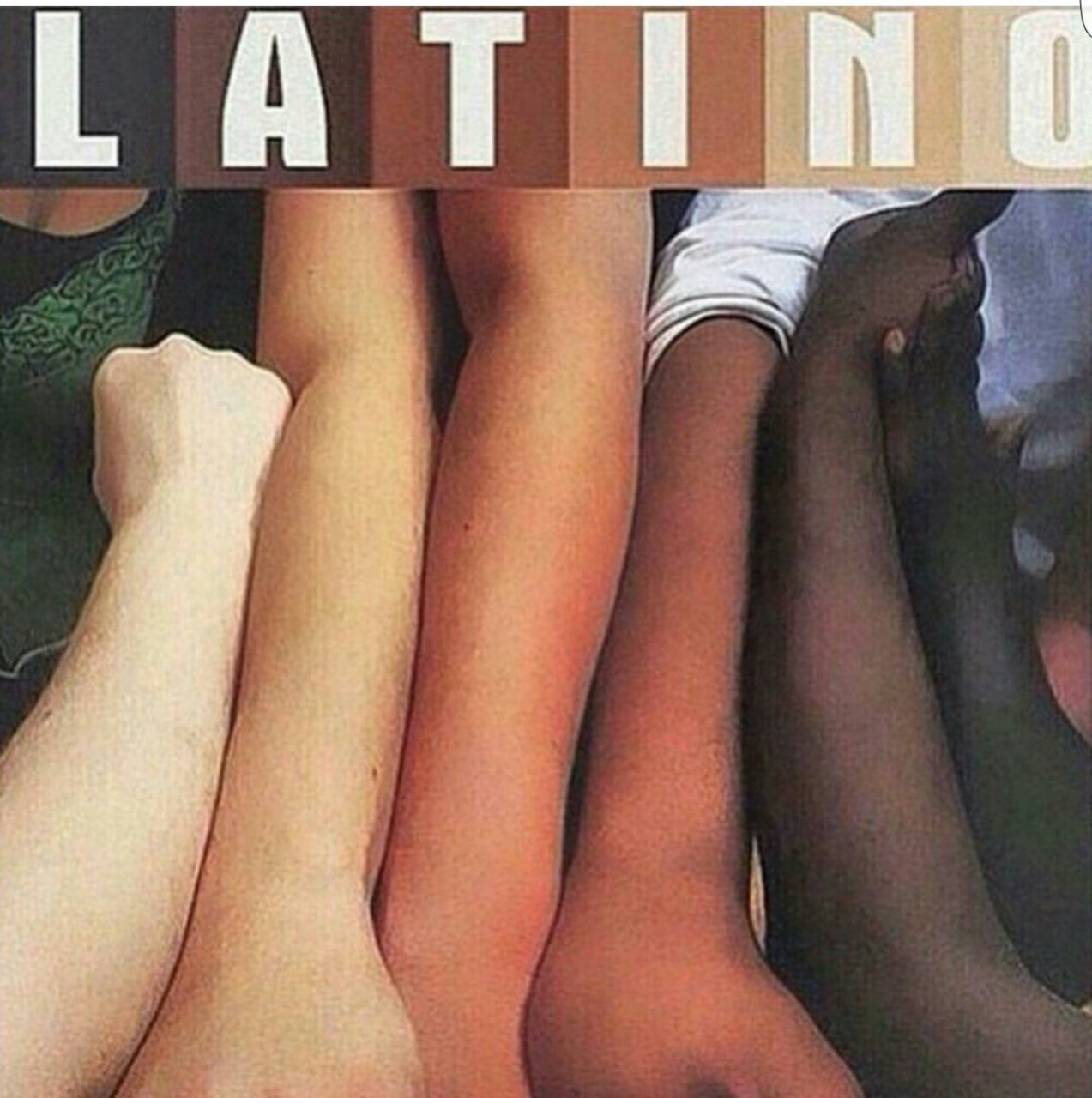
Image result for latino skin tones
     With the evidence found in the film, my perspective of how I see my race is more complex. I identified myself as a Latino, which the word Latino is used to describe someone’s origin from a Latin America country. Latin Americans all have different skin tones, even if they are from the same country. In the Article “Doing Race,” by Nilda Flore-Gonzalez, it states that  Latinos are a “racially heterogeneous group with White, Black, indigenous, and even Asian origins” (Flores-Gonzalez, 1835). Latino or Hispanic aren’t consider a race and many Latinos identify their race by their nationality. Both my parent were born and raised in Ecuador and I am their only child born in the United States. Being born in the United States considers me as an American, but when I am asked my nationality, my instant responds is Ecuadorian. I was not born in Ecuador, but I determine my race by my parents origin. The article “Doing Race,” explains how many Latinos identify as the other race because they do not identify themselves as Whites or Blacks. In the article “From Bi-Racial to Tri-Racial” by Eduardo Bonilla-Silva, it states how a big portion of Argentineans consider themselves as White and some Dominicans consider themselves as Black or the other race. This shows me that even in the Latinos “race,” there is a big difference on how Latinos consider their race.

Work Cited

Bonilla-Silva, Eduardo. (2004). “From Bi-Racial To Tri-Racial": Toward a New System of Radical Stratification in the U.S.A. Ethnic and Racial Studies, Vol 27, (931-950) 

Flores-Gonzalez, N., Aranda, E., & Vaquera, E. (2014). "Doing Race": Latino Youth's identities and the Politics of Racial Exclusion. American Behavioral Scientist, 1834-1851.

Nelson, Alondra. (2008). “Bio Science: Genetic Genealogy Testing and the Pursuit of African Ancestry.” Social Studies of Science, (759-783)

Race: The Power of an Illusion, Episode 1:Difference Between Us (Documentary). (2003). California Newsreel.

External Links

Revision: The Misinterpretations of Race

Ingrid Diaz                                                                                                         September 21, 2016
The Misinterpretations of Race
Race is defined as a group of individuals that share supposed physical and/or genetic traits. The sociological concept of race suggests that we are socialized to differentiate individuals by their physical/external attributes. We are brought up to believe that we can identify another individual’s race just by looking at them. We divide individuals into categories of race based on the color of their skin, the texture of their hair, and the shape/color of their eyes. Because we are socialized to accept and integrate the concept of race into our lives, we try to attribute these physical/external differences to internal differences. The scientific concept of race suggests that these external attributes must derive from some sort of genetic similarity.
In the film “Race: The Power of an Illusion, Episode 1,” Pilar Ossorio states, “there is just as much or more genetic difference between individuals within the same racial group as there is between different racial groups.” In this same film, a group of students had their mDNA tested for genetic markers. Mitochondrial DNA is passed down to an individual from their maternal side. The group of students consisted of different races including Black, White, Asian and Latino. Before the study was conducted, the students hypothesized that they will have more similarities with others that are racially the same as them. However, the results proved Ossorio’s statement. The student’s mDNA demonstrated that the students had just as much or more difference with the other students that were racially the same as them than with the students who were not racially the same. The physical traits that we adapt through environmental differences do not reflect genetic differentiation (Templeton, 2013).

https://goo.gl/images/wMHixZ
 
According to the United States Census Bureau, there are five races in which an individual can identify with (http://www.census.gov/topics/population/race/about.html). These races include White, Black/African American, Asian, Native Hawaiian/Other Pacific Islander and Other. An individual can mark more than one box in this section of the census. This makes it difficult for me to choose a race when filling out forms because I do not identify myself with any of these races. I consider myself Hispanic and not any of the previously mentioned races. However, according to the United States Census Bureau, Hispanic and Latino is not considered a race instead they are considered an ethnicity. Ethnicity is defined as belonging to a social group that has similar cultural backgrounds.

https://goo.gl/images/2OXv0U
Noticeably, many individuals of Hispanics and Latino/a ethnic background have been identifying themselves as white. According to a New York Times article, researchers found that approximately 2.5 million of Hispanics/Latinos who choose “Some Oher Race” in the 2000 census changed their race to “White” in the 2010 census (http://www.nytimes.com/2014/05/22/upshot/more-hispanics-declaring-themselves-white.html?_r=0). This research suggests that in fact choosing a race can be very confusing for Hispanics because the options provided are not relevant enough. According to “Criollo, Mestizo, Mulato, LatiNegro, Indigena, White, or Black? The US Hispanic/Latino Population and Multiple Responses in the 2000 Census,” the way that Hispanics identify their race is based on what age the individual entered the country, socioeconomic status, and the ability to pass as White. This suggests that Hispanics are labeling themselves as white based on stereotypical beliefs of what it means to be white.
 
Works Cited
Amaro, H., & Zambrana, R. E. (2000). Criollo, Mestizo, Mulato, LatiNegro, Indigena, White, or Black? The US Hispanic/Latino Population and Multiple Responses in the 2000 Census. American Journal Of Public Health, 90(11), 1724-1727
Templeton, A. R. (2013). Biological races in humans. Studies in History and Philosophy of Science Part C: Studies in History and Philosophy of Biological and Biomedical Sciences, 44(3), 262-271. doi:10.1016/j.shpsc.2013.04.010
 

Revision : Survival of the Fittest

Christopher Colon
Ethnic Minority Groups 25300
Dr. Lewis McCoy


http://www.latinorebels.com/wp-content/uploads/2015/08/14609019479_3631a0fa72_h-700x479.jpg


              Survival of the Fittest


The mistreatment of people of color throughout history was justified with religious and scientific racist ideologies. Hierarchical racial concepts were used to make sense of the physical and culturally differences between people while also promoting white supremacy and Black inferiority. Race is a complex concept that is constructed to maintain white superiority perpetuating ideologies that are still lived out today. For those who held positions of power in the United States, “scientific racism was central to most human and social inquiries” (Golash-Boza pg.23). Our society can’t help to judge individuals off phenotype and place them into racial categories. I recognize the power race has on my everyday life experiences.
In the documentary, “Race: The Power of Illusion, Episode 1”, Pillar Ossorio’s claim that there is just as much or more genetic differences within the same racial group debunks the racist biological and scientific ideologies scientists created to explain differences between races. The Eugenics movement of the 20th century, “promoted the idea that not only intelligence but alcoholism, laziness, crime, poverty and other moral and cultural traits can be inherited”, which was a scientific attempt to explain why people of color were “biologically unfit” (Golash-Boza pg.27).
These ideologies influenced the passing of racist laws such as Law 116 in 1936, that made forced sterilization legal and free for women in Puerto Rico (Presser 1969). Colonialism, eugenics and population control has played a huge part in hindering the upward mobility of Puerto Ricans creating stereotypes like laziness and violent. Racist laws and actions from the past has paved the way for racist ideologies that has negatively shape the lives of people of color worldwide. People of color are still feeling the ill-effects of slavery and colonialism which has also shape the way people think of each other. 
My parents were born in Puerto Rico but I was born in Brooklyn, New York. Growing up people will always tell me “I look Dominican” but once I talked, they would say I “act Black”. I always wondered what it was to “act Black” because according to me, I acted like myself. I grew up proud to come from Puerto Rican descent. My living experience alongside African Americans in New York influenced me to embrace my Black identity. As I grew older I began to identify as Black, though people would insist in telling me I’m “Spanish”. However, I wanted to break away from that “Spanish” colonial mind state and embrace my African roots. I now identify as being a Nuyo-Rican or Afro-Puerto Rican.
Though I understand how race is not biologically proven, I do realize how race determines the way I get treated by police and how my family has been socially affected by this concept. Race is a concept I am trying to understand more than ever because I take pride in the perseverance people of color have endured throughout history. This counters scientist Herbert Spencer’s “survival of the fittest” theory that claimed Natives were naturally inferior to explain their decimation (Golash-Boza 2016). People of color are still experiencing the racist ideologies of yesterday which can be heard today in presidential candidate Donald Trump speeches. However, racist ideologies have forced to me to love the things they hate about my culture.


Links:


Citations:

  •        Golash-Boza, T.M. (n.d.). Race and racisms: A critical approach. Oxford 2016·     
  •        Gooding-Williams, R., and West, C. (1995). Keeping Faith: Philosophy and Race in America. The Philosophical Review, 104(4).
  •        Presser. H.B.(1969). The Role of Sterialozation in Controlling Puerto Rican Fertility.   Population Studies, 23(3), 343. Doi:102307/2172875.2307/2172875
-California newsreel. "Race - the Power of an Illusion." YouTube. YouTube, 2009. Web. 03 Oct. 2016.


 diversitynowbyegloballearning.blogspot.com


Revision: Sociology v. Biology

Linda Mercedes                                                                                  October 3, 2016


Image result for racial
http://povertylaw.org/index.php?q=civicrm/mailing/view&reset=1&id=481
People nowadays are very preoccupied with race. When they first meet you, that is the first thing they assume about you. Then they may proceed to ask just to make sure that their prediction is correct. Race is defined by phenotype, and although a lot of times one is able to make an educated guess on someone’s race by their looks and be right, this is not always true. My mom and I, for example, are both Hispanic but by looking at us you would not be able to guess that. My mom is pale and is often mistaken for white. Meanwhile, I am of a darker complexion than her and often get associated with someone from the Middle East.
In the documentary, “Race: The Power of an Illusion, Episode 1,” a group of students conducted a study to see if they were genetically similar to someone of their own race. The students assumed that they would be most similar genetically to those in their same race. In actuality, however, they shared more similarities with someone of a completely different race than their own. This helps to prove that race is not genetic. In the book Race and Racisms: A Critical Approach, Golash-Boza (2016:3) states that if you walk from Kenya to Sweden to then China, you would notice the physical differences between the people but you would not know where to draw the line between the continents. She also states that race was constructed in order to provide justification for mass genocide and the exploitation of Native Americans and African slaves. Taking this into consideration, we can take a look at the Irish, who were once considered a separate race by the British in order to justify their inferiority, but now they are both under the race “White.” In his article, Daniel G. Blackburn (2000) talks about how some eighteenth century taxonomist identified three racial categories, while others identified many more than three. If race was biological, how can the racial line be adjusted and readjusted over time?
Golash-Boza also talks about how scientists used craniometry to show that Whites had bigger brains therefore are more intelligent. This study was biased, however, and ignored the reasons for the variation in sizes. McChesney (2015) states in his article that DNA comparisons show that all humans existing today originated in Africa and the migrations from Africa to other parts of the world are responsible for the variations in the human species. In the YouTube video “Science Says: There is No Such Thing as Race!” it is stated how science does measure variations in the human species, but these variations are not due to race but to adaptations to different environments and climates. If race was in fact biological, then the understanding of race would be universal, but it is not, it changes depending on what country you are from. The video also proceeds to saying that ethnicity, unlike race, is very real and I agree. I realized that when someone asks “Where are you from?” I always say “I am Dominican.” I identify with my specific ethnic culture rather than saying “I am Hispanic,” which is broad and more along the racial line. I identify with my culture but I am not sure if I identify with a specific race. By default, however, if you tell someone that you are Dominican they say “Oh, you are Hispanic.” The only problem with this is that people fail to acknowledge the differences within a race by grouping everyone together. For example depending where you live in the United States, being Hispanic has a different meaning. In the west, Hispanic equates to Mexican.

http://thebrazilnotebook.weebly.com/racial-inequality.html

URLs:
https://www.youtube.com/watch?v=RK3sguRWYK0
http://www.historytoday.com/tom-reilly/cromwell-irish-question

References:

Blackburn, Daniel G. 2000. “Why Race is Not a Biological Concept.” Pp 3-26 in Race and Racism in Theory and Practice, edited by Berel Lang. Lanham, MD: Rowman and Littlefield Publishers, Inc.
Golash-Boza, Tanya Maria. 2016. Race and Racisms: A Critical Approach Brief Edition. New York, NY: Oxford University Press.
McChesney, Kay Young. 2015. “Teaching Diversity: The Science You Need to Know to Explain Why Race Is Not Biological.” Sage Opens 5(4): 1-13.